UNBOXING#5 _Darta Sidere
UNBOXING Vol.2_With Atelier 13F opens its first chapter by presenting the work of Darta Sidere.
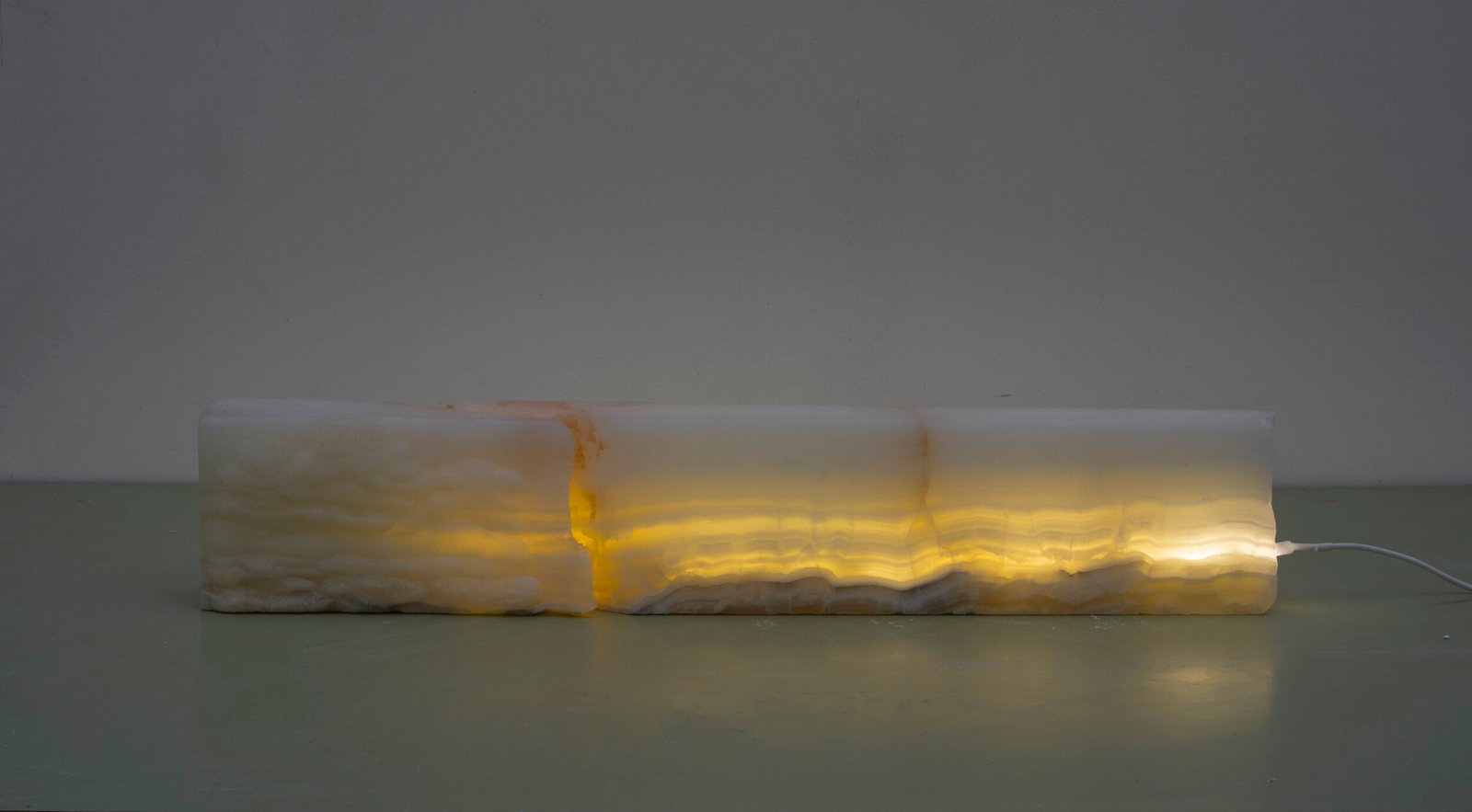
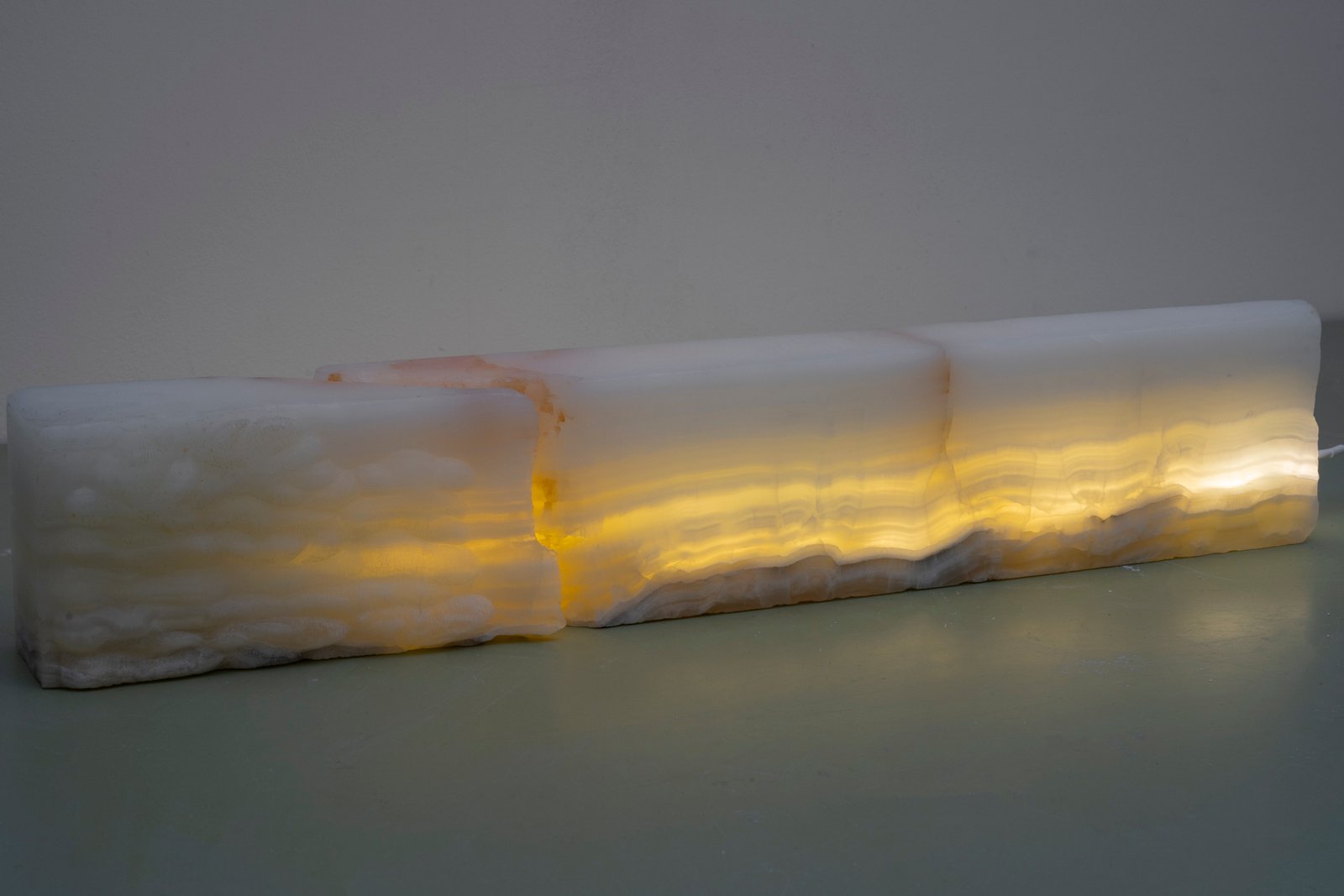
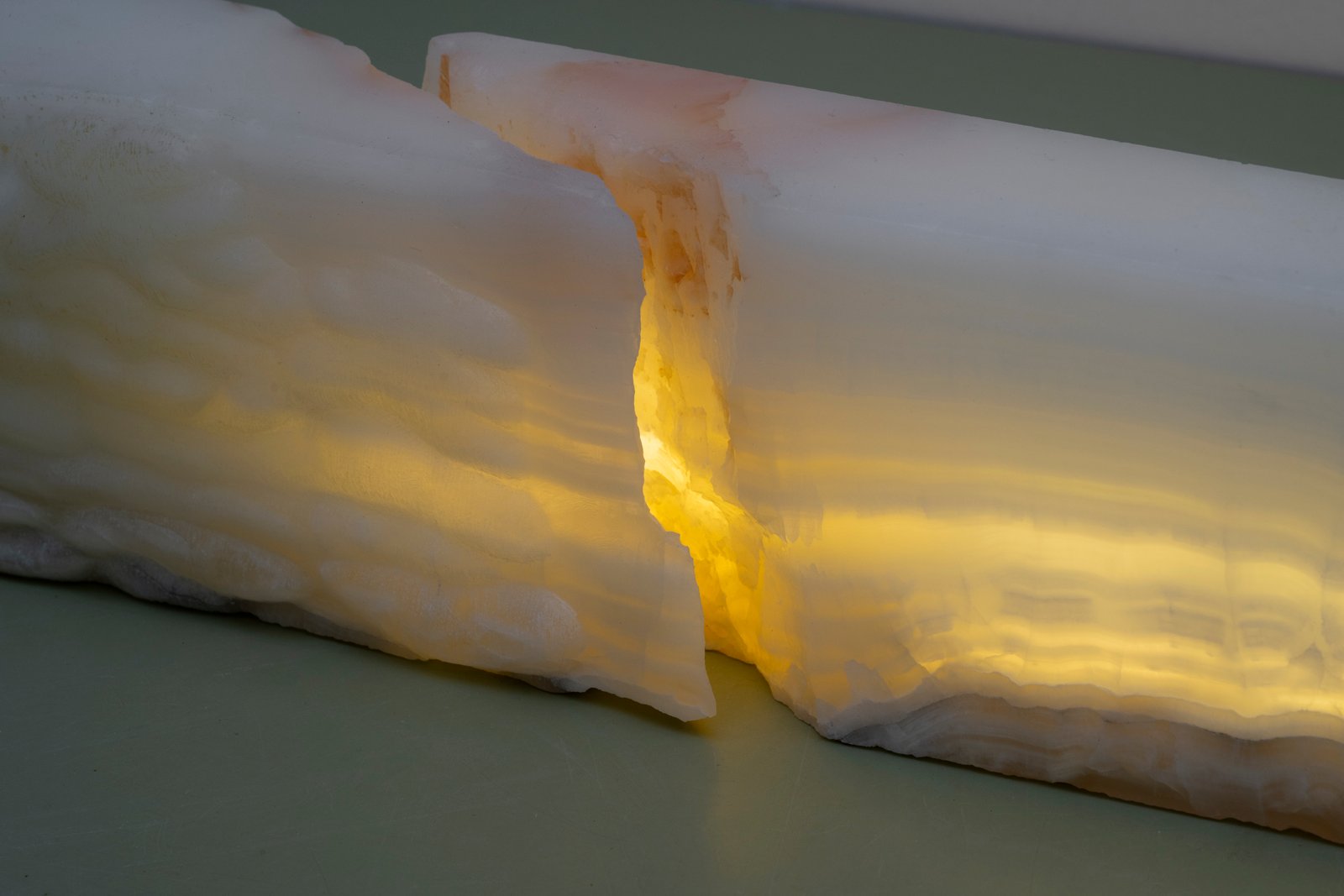
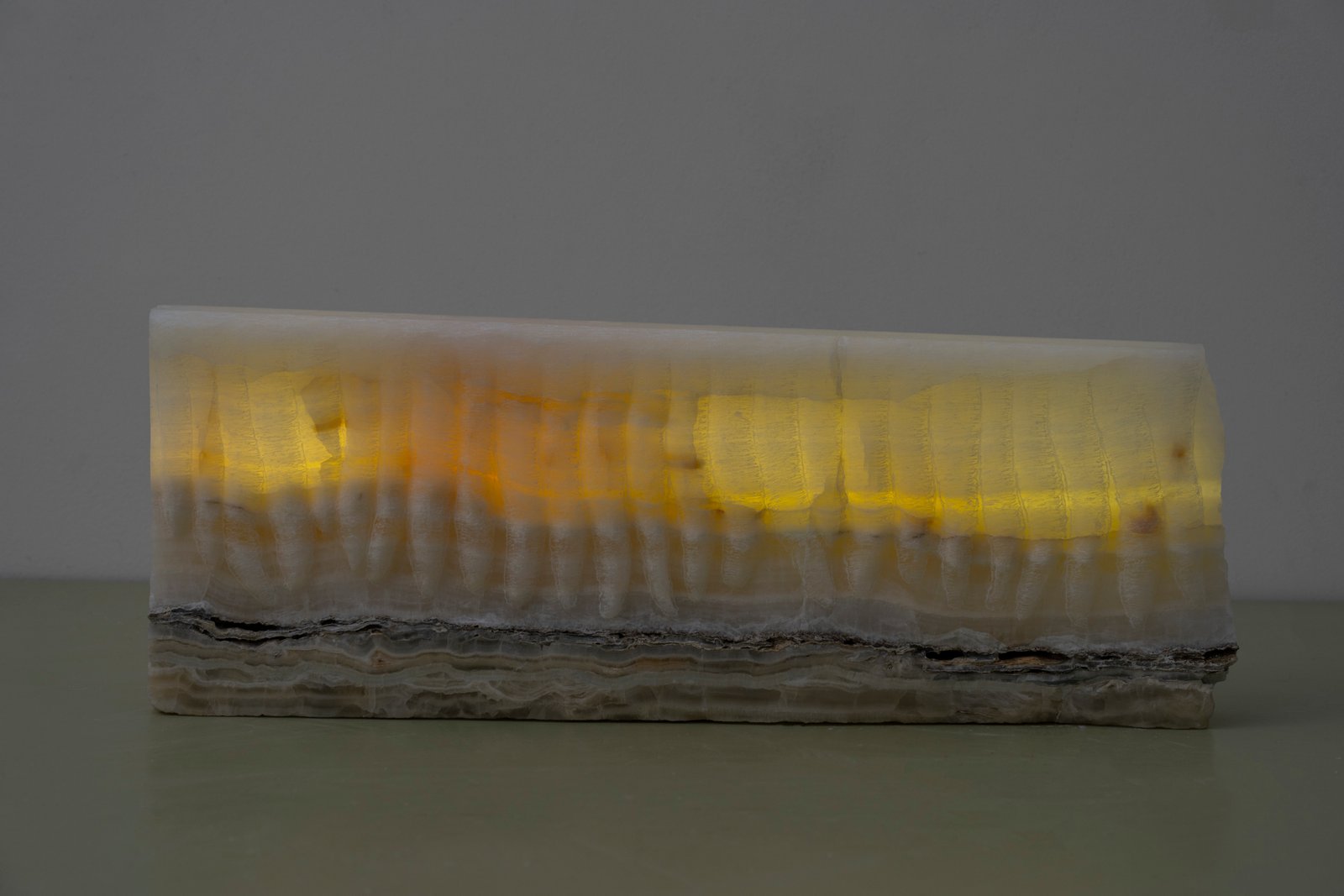
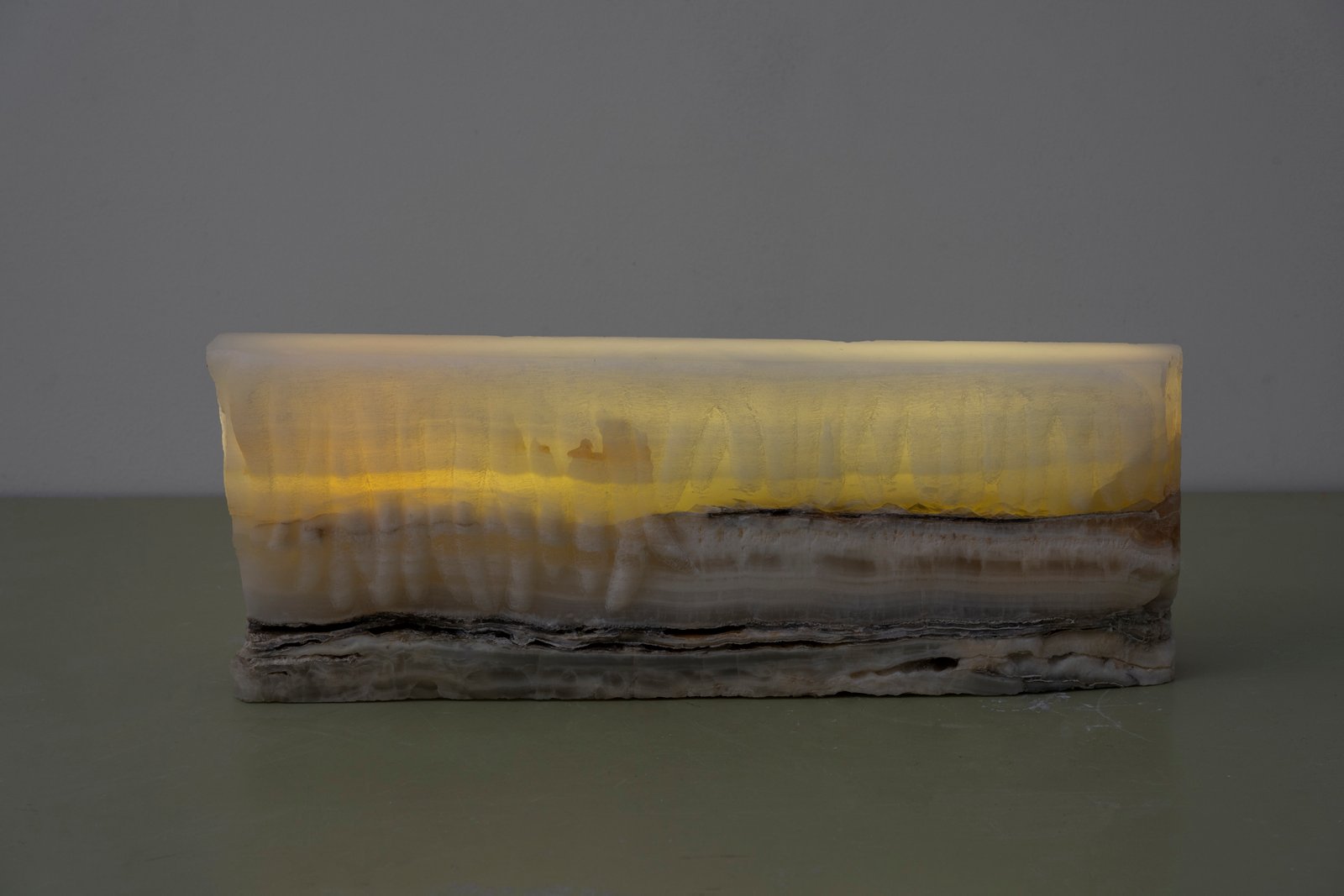
Darta Sidere’s participation in UNBOXING unfolds through a new series of light sculptures — part of the project Les creux de temps — inspired by her visits to the Gouffre de Padirac and the Grotte de Clamouse, two underground sites in the south of France¹.
These latest sculptures belong to the broader research the artist has been pursuing for years, through a body of work (sculptural pieces and installations) that evolves mainly with stone as its medium of choice. More precisely, this inquiry explores the boundaries between body and environment through the transformation of matter touched by the gaze, what is known as haptic perception.
It is an approach in which organic fragility, softness and fluidity meet the hardness of the mineral world, the force of the elements and that of the artist’s own gesture as she handles the material. A process that extends beyond the relationship between eye and surface, towards a more tactile connection with matter. In the pieces of the series Les creux de temps, we find this same relation between the mineral qualities of stone — its hardness, its weight or vulnerability — and the way the artist’s hand works it to make it polished, pliable, liquid.
The word creux (hollow) denotes primarily a void, a recessed space or an inner depth.
Darta Sidere
Coralloïdes, 2026
Yellow onyx, LED strip, aluminium
11.5 x 60 x 6 cm
Image credit : Paul Hennebelle, Flâneur studio
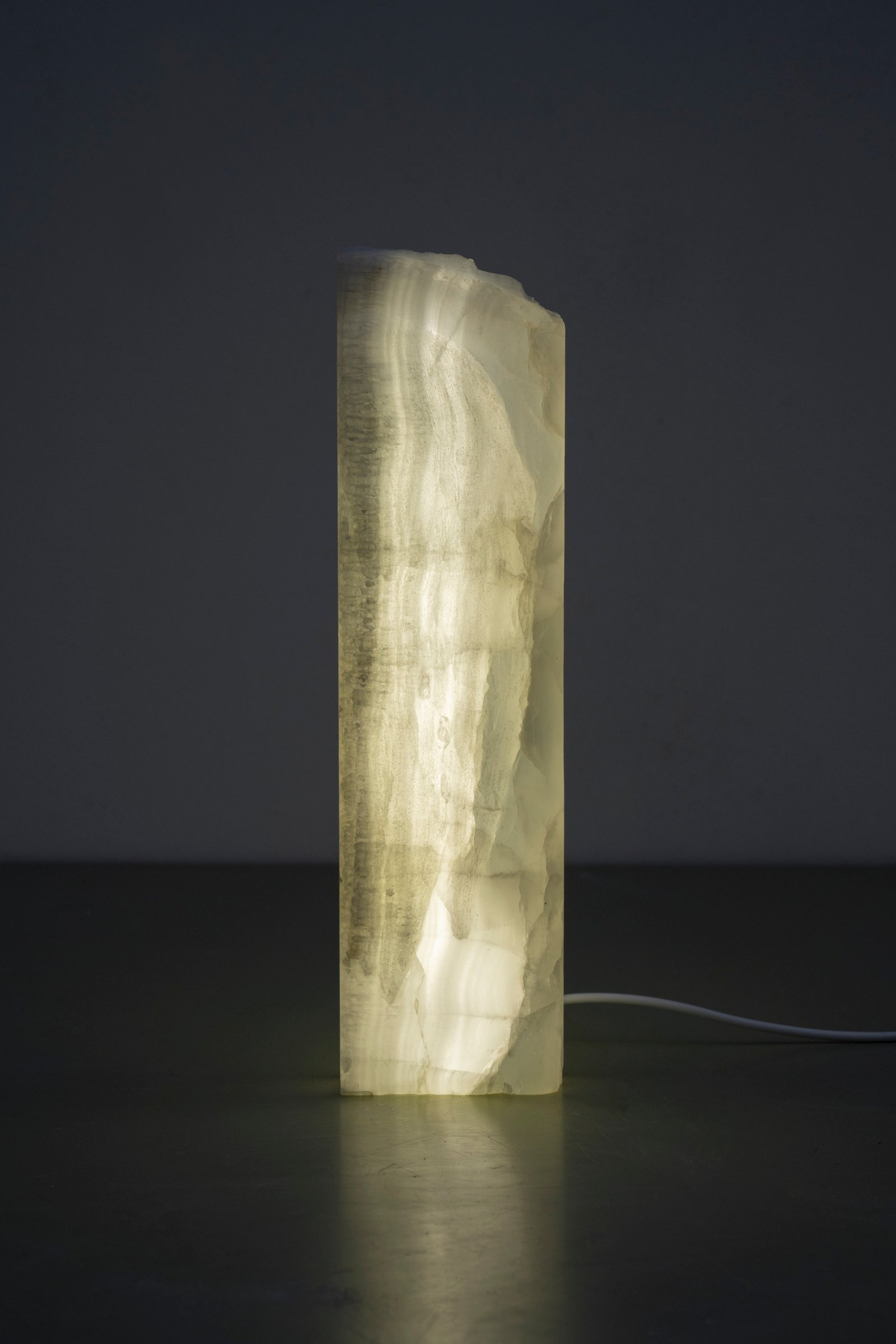
Darta Sidere
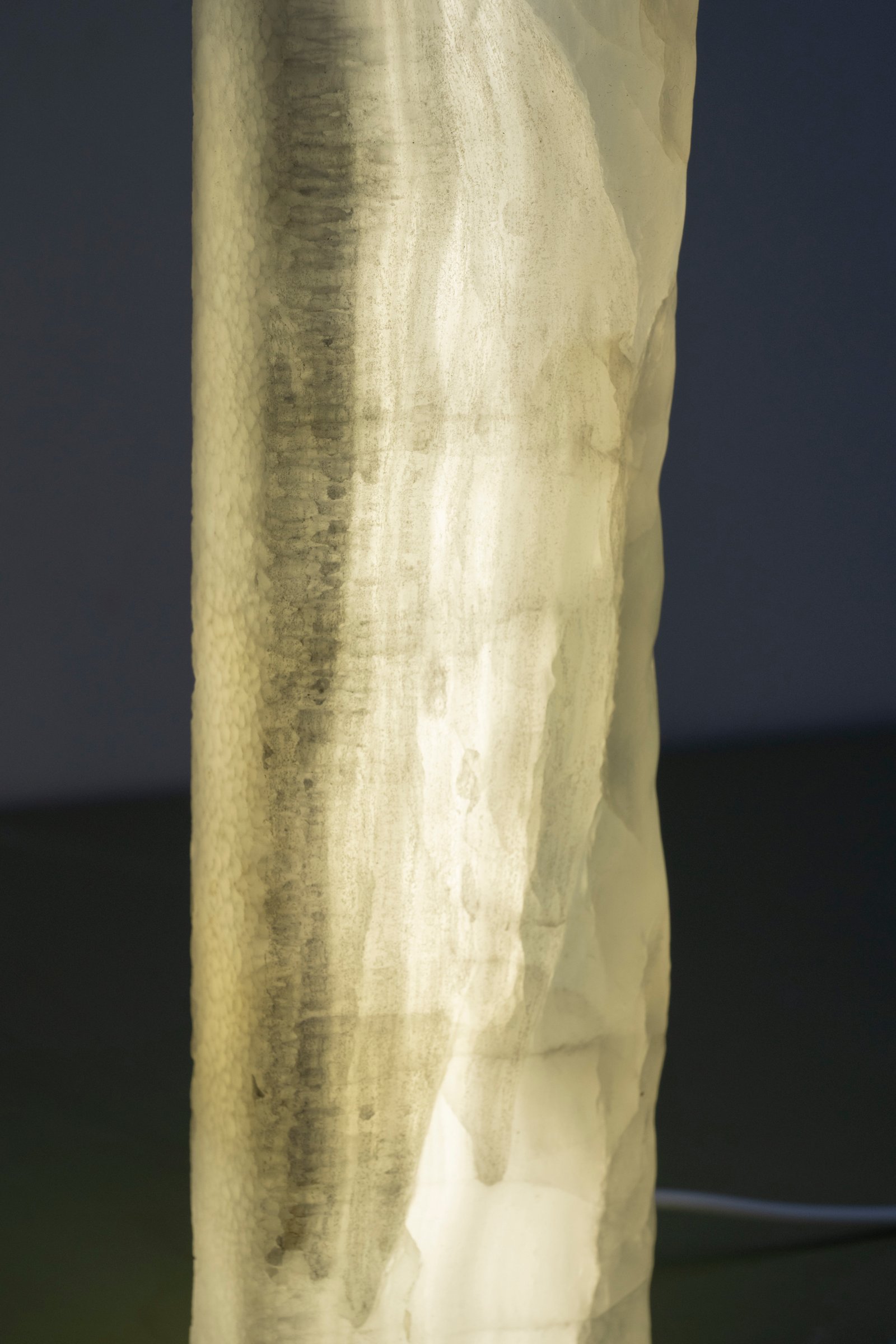
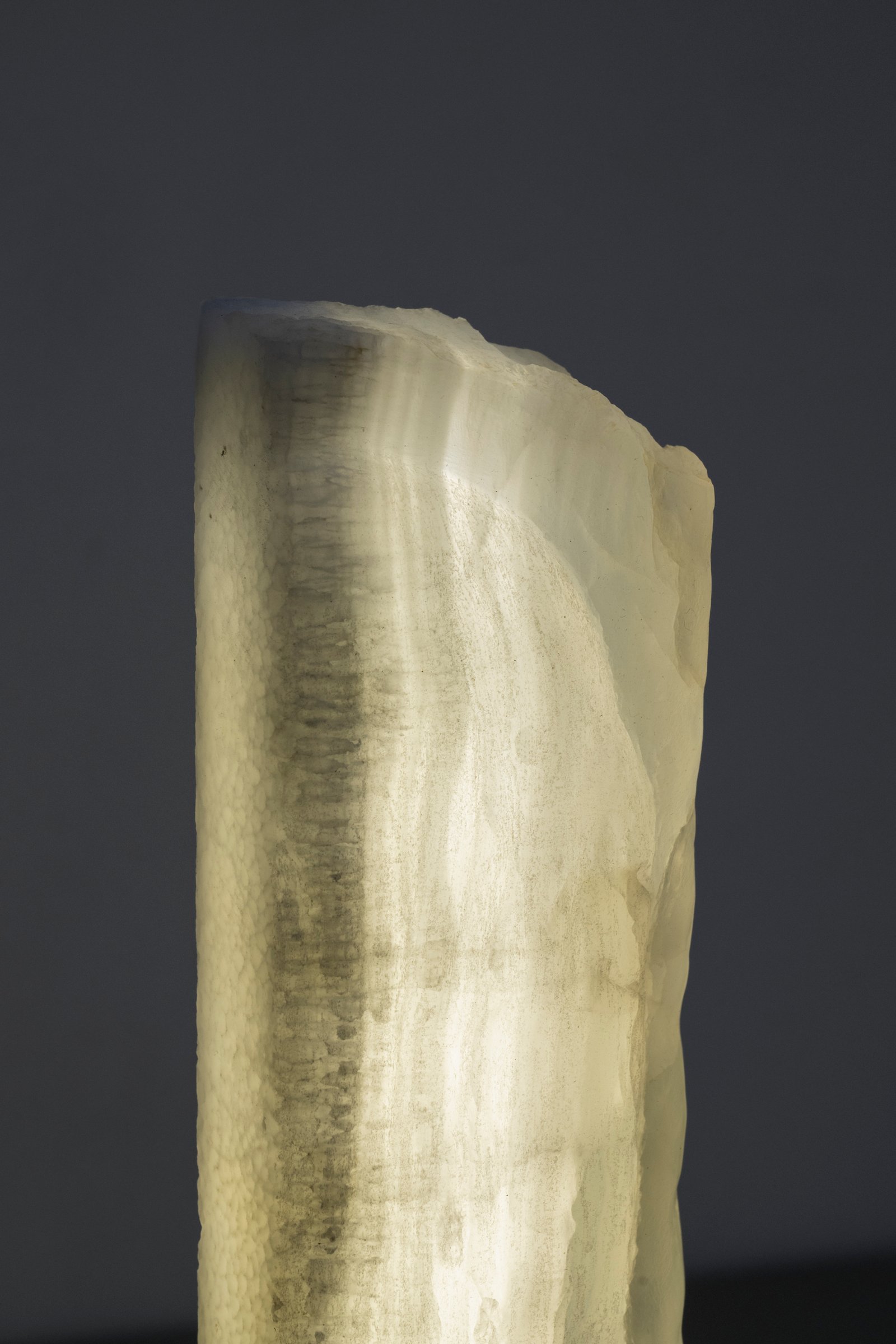
Draperie, 2026
White onyx, LED strip, aluminium
25 x 6.5 x 3 cm
Image credit : Paul Hennebelle, Flâneur studio
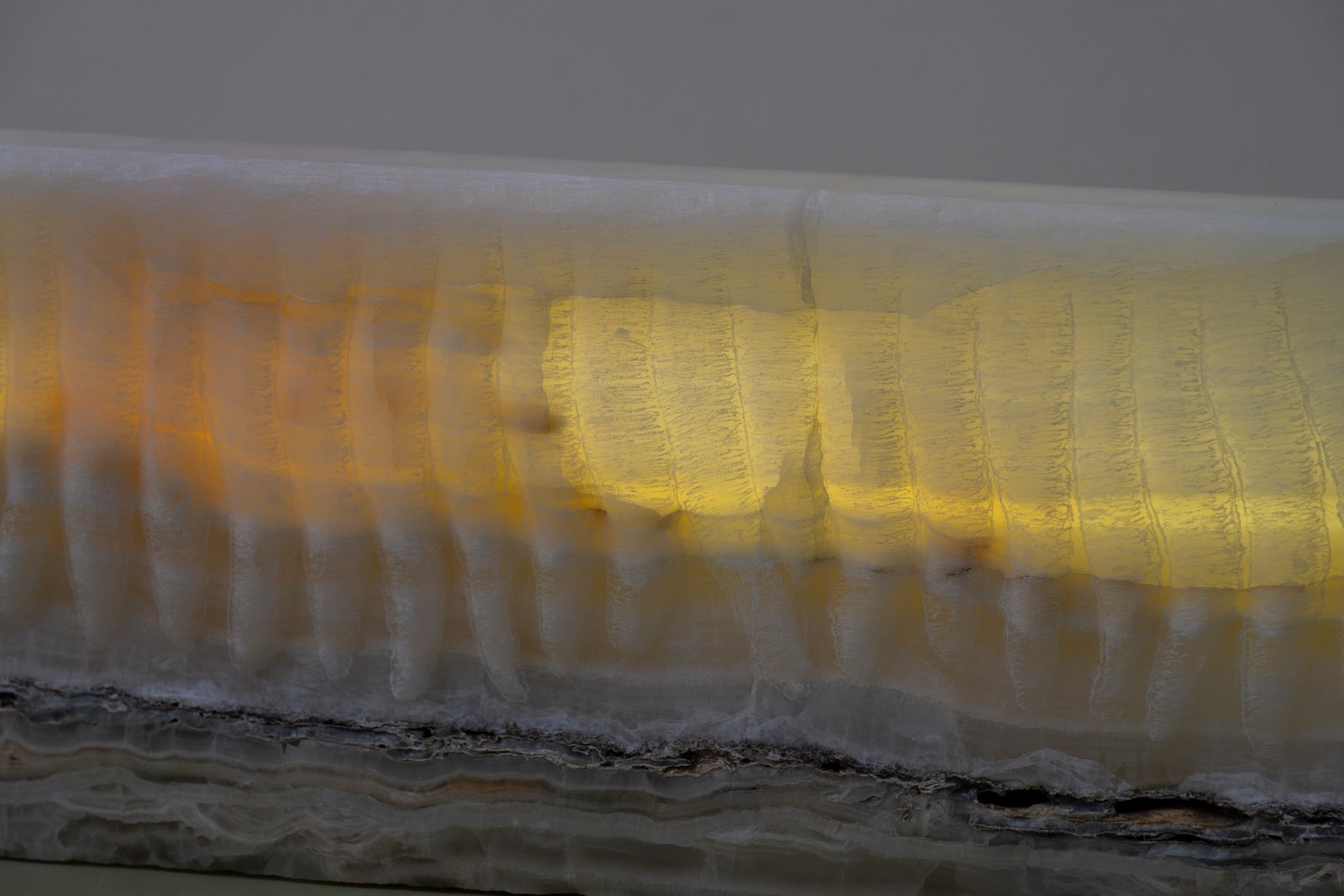
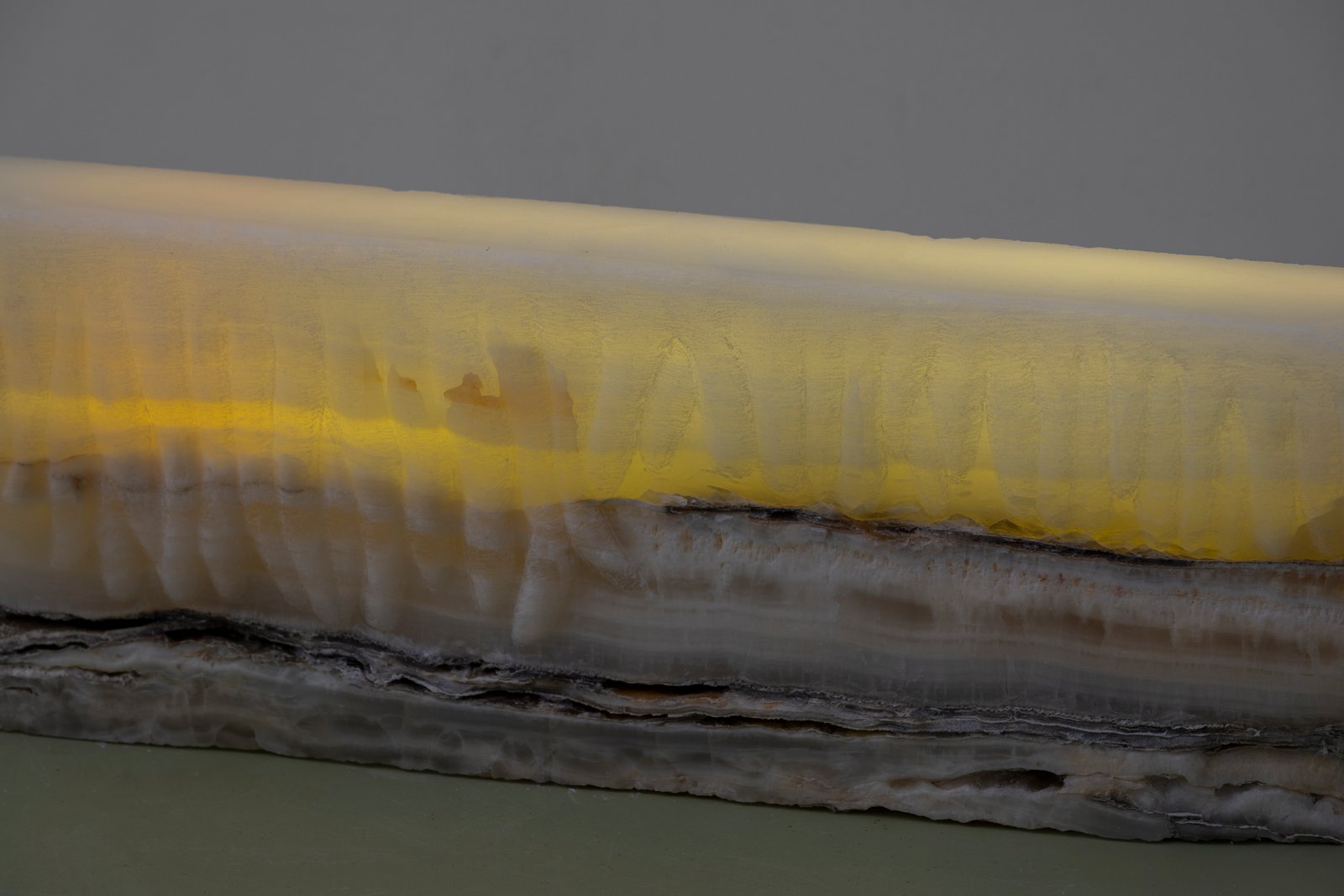
The pieces on view in UNBOXING — Draperie, Coralloïdes, Fistuleuses — evoke the crystalline
formations that make up the landscape of caves. These dark, mineral ecosystems lead Darta Sidere to create works whose composition includes, for the first time, a light source.
The sculptures are made of onyx, a banded variety of quartz whose layers differ in colour or degree of transparency. Light passes through the sculptures, following their forms, outlining and deepening the details of the material, its veins and its skeleton. It reveals the network of translucent bands that compose the onyx and overlap the strata worked by the artist. Within the continuity of the surface, matter and gesture-relief merge, blurring, to the eye, the distinction between the two.
Both fragments and fragmented, the works find a form of reassembly through light itself. They glow in
UNBOXING, from the studio to the screen. They stretch out vertically or horizontally, standing alone or
placed close to one another. Their lighting system sometimes responds to the luminosity of the space, or is activated by movement detected nearby, as in underground galleries.
Darta Sidere
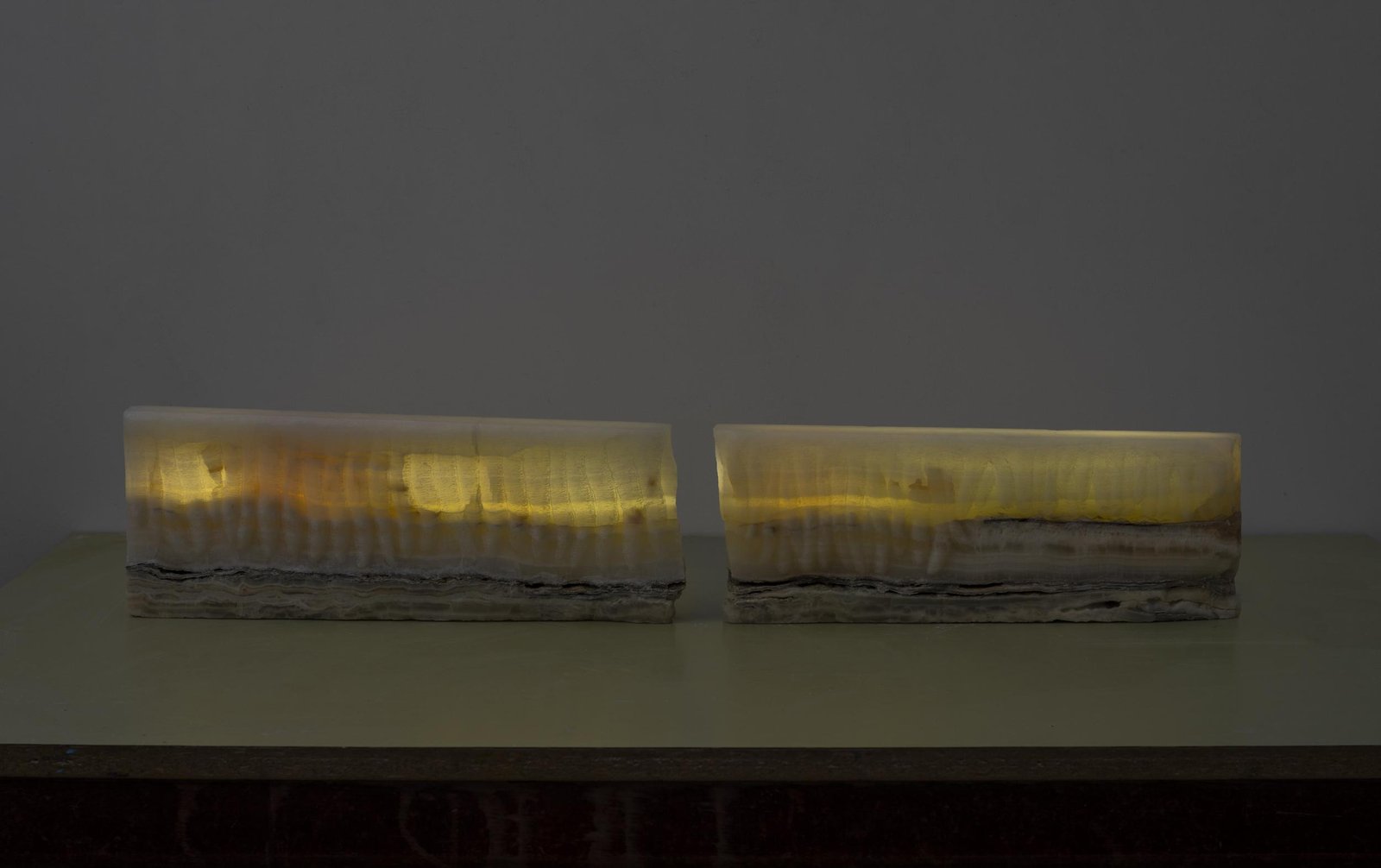
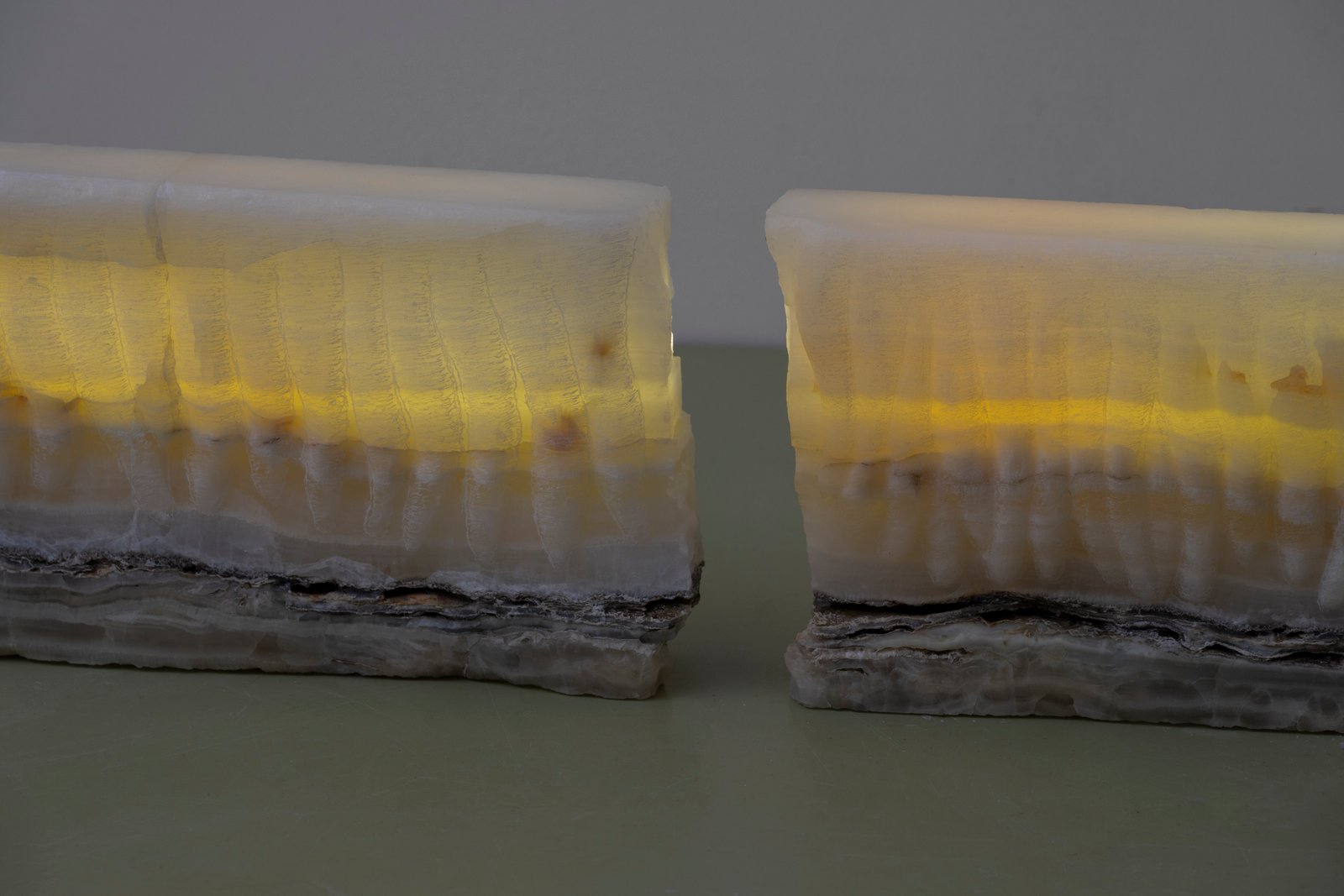
Fistuleuses I & II, 2026
Yellow onyx, LED strip, aluminium
I: 16.5 x 43 x 4.5 cm
II: 15.5 x 41.5 x 5 cm
Image credit : Paul Hennebelle, Flâneur studio
Darta Sidere thus draws on the mineral depths of the earth, exposing the textures, reliefs and cavities shaped by the elements over geological time. Among underground concretions, she is especially fascinated by the soda straws (fistuleuses in French). A fistuleuse is a tubular, monocrystalline concretion that grows vertically and hangs from the ceiling. Seepage water flows inside the tube and deposits calcite on its rim. It can reach several tens of centimeters in length while keeping a diameter of a few millimeters, equal to that of the water drops from which it originates.²
The Fistuleuses channel the artist’s reflection from the material to the temporal dimension, within the cave-space. Slender tubular stalactites, they are indeed markers of an expanded geological timescale that unfolds over millennia. This temporal void resonates with the etymology of the term fistuleuse, derived from the Latin fistulosus, “hollow,” itself linked to fistula, “tube” or “pipe.” The word creux thus takes on a new meaning as an interval of time, a tempo morto (Italian for “dead time”), a period of waiting or apparent stillness.
Darta Sidere’s project Les creux de temps is also partly inspired by the hors du temps journeys embarked on by the French geologist and speleologist Michel Siffre (1934–2024). In 1962, he carried out his first long-term confinement experiment, remaining alone for more than two months at the bottom of the Scarasson chasm (Marguareis massif, in the south-western Alps, on the Italian-French border). Michel Siffre subsequently organized further expeditions aimed at studying the physical and psychological responses to underground confinement and, above all, how the human body regulates and perceives time when confined in an extreme environment, without natural light and under harsh climatic conditions.
In his book Expériences hors du temps – L’aventure des spéléonautes (1972, Éditions Fayard), Michel Siffre retraces his own underground journeys as well as the explorations documented by his colleagues during the 1960s. His narrative evokes a human temporality which, deprived of cosmic or social markers, seems to speed up and slow down in each researcher’s perception. Moreover, between 1999 and 2000, Michel Siffre spent 77 days underground in the Clamouse cave, which Darta Sidere also visited.
The artist’s encounters with underground cavities and hollows echo Michel Siffre’s own experiences: a dilated temporality, devoid of any expectation of what might happen next.
A seemingly motionless geological time in which, nevertheless, change and metamorphosis are constant.
Darta Sidere’s word creux also resonates with Michel Siffre’s hors du temps accounts, in their description of a human time which, enveloped by the mineral fabric, no longer knows waiting and is deprived of any awareness of duration. Siffre further reports the effects that disruptions of the biological cycle have on memory, which lead to amnesic episodes (gaps or hollows) over the course of the underground experience.³
Darta Sidere’s works and Michel Siffre’s experience converge within the UNBOXING project, finding there a new, essentially virtual ground of reception. Through the illuminated onyx stone, the artist leads us from a material perception to a sensory perception of time, evoking this underground space where human and mineral ages meet and the scales of existence overlap.
It is therefore interesting to draw a connection between the temporal-mineral dimension and that of virtual time, of the digital hollow, where limits and markers shift, allowing an extreme dilation or contraction of time.
How do we perceive time in the depths of a cave?
How do we perceive time in the digital abyss, scroll after scroll?
What relationship is woven between real time and intuitive time, between the time we experience and the time we perceive subjectively?
Side by side, Darta Sidere’s luminous sculptures trace the path leading to these real or virtual depths. Their reverberating glow becomes a landmark, the same light that influences the perception of human time flowing through the abyss, from the cave-space to the studio-space and on to the light of the screen.
1. The exploration benefited from the ADAGP research grant (2026).
2. Guide des reliefs – Réserve naturelle des Hauts de Chartreuse : Formation and Fragility of Soda Straws.
3. Michel Siffre, Expériences hors du temps : l’aventure des spéléonautes, Paris, Fayard, 1972, p. 241 : « Il est bien connu que l’attente fait prendre nettement conscience de la durée et que le temps paraît plus long que d’habitude. Or, et c’est un facteur non négligeable, l’attente immédiate n’existe pas dans la vie en dehors du temps. ». Ibid., p. 242 : « Le manque de repères cosmiques ou sociaux a coïncidé avec l’affaiblissement de ce qui me semble être le facteur le plus caractéristique dans l’accélération et la perte de la notion de temps : Je veux parler de la mémoire. »

Emilia Shine
Rétine, 2022
oil on canvas
116 x 90 cm
“I lost I lost – What?
Ah yes – My head”
(INCIPIT)
The genesis of the project is the conversation between Emilia Shine and Léa Petges, a poet-writer she (Emilia) met in Mexico. The geographical and temporal shift is introduced into the story that Emilia – probably – wants to tell us. These texts and exchanges contribute to the creation of the work.
Yet the narration is not inspired by the pictorial work, and does not necessarily translate its content.
These writings open an IN-exclusive channel of interpretation. Léa Petges designs a text that lives for itself, that she generates beyond painting. Over the course of the exchanges, it is impossible to establish the extent to which the narrative overlaps with the image, how one is absorbed, contaminated by or kept distant from the other.
The riddle may be one of the only truths here.
In the painting “Silence de Porcelaine”, the frames of the composition are superimposed on each other, layers of a seemingly frozen story.
Here, the folds and the flesh of the exposed female body contrast with the dog-sphinx frozen on its pedestal. The rigour of the dog is opposed to the violence of the volcanic eruption, to the trickle of lava (blood) that flows in the background, to the same fiery liquid offered by a woman’s hands. The dog’s inertia echoes the character/child at the centre of the composition, and the cross planted on the ground.
A cross, a cow, meat and a body. How does our thinking develop these images?
Where are they in our head? Where is our head?
Emilia’s paintings are expressed through the script of a story which is open to all codification. Fragments of memories, real or invented elements, automatic, imaginary or flashback writing. Elements of a collage to be recomposed, according to one’s own intuitions and impulses.
Like Hydra, the water snake with multiple heads. Cutting off one head only means generating more.

Emilia Shine
Silence de porcelaine, 2022
oil on canvas
116 x 90 cm


Emilia Shine
Porcelaine, 2022
oil on canvas
24 x 18 cm

He lost his mind… or his memory.
Honestly he got nothing left, just some pictures , some objects and memories. In front of his big mirror he doesn’t know what to do… he looks at himself and remembers…what exactly I don’t know…Like a child that dives into its imaginary, inventing himself a story. And I would like you to tell us the story

(CLUES)
Emilia Shine’s narrative continues with clues, with “found objects.” More precisely, with images of objects, taken out of their ordinary contexts.
Everyday things, belonging to a specific person, or otherwise, that become connection tools, assimilating new reasons. Amongst these “emblems,” the artist presents artifacts that are part of her heritage, her personal and family history.
Such objects – wrapped in an amnesic veil – carry the trace of events that no one seems to remember. Amnesia is the difficulty of retaining information in memory, a memory that therefore works by uncontrollable associations. Perhaps one day, these/her objects will allow for these associations to be rebuilt within a potentially existing frame.
Emilia reproduces some of these objects in ceramic, giving them a new status. The transition acts from the everyday object, to the object-work, to its image representation, to its digital state.
Within UNBOXING#4, some objects activate a sound dialogue (based on the reading of the original text by Léa Petges). Pieces of history. A man and a woman who will perhaps never meet again, who perhaps never really met. Relics or talismans, these clues activate the narrative of the story, on the basis of which the final animation is articulated in turn.
As common objects, taken out of their original context, they assume the value that each spectator assigns to them according to their memories. The choice is left to the visitor/user to tell the more or less real story that is activated by the object. Emilia Shine’s clues show how an image of a banal thing, globally recognised for its form and primordial function, can trigger a narrative that is totally different to its origin.

Found object 3
Le bougeoir, ceramic with sound
(hover on the object for the sound or read here the text by Lea Pedge)

Found object 4
Le peigne, ceramic


Emilia Shine
Le champs de blé, 2022
oil on canvas
140 x 140 cm

Found object 2
La chienne, ceramic

Emilia Shine
Rince toi à l’eau du lac, 2022
oil on wood and plastic
31 x 23 cm

Found object 1
Le miroir, ceramic with sound
(hover on the object for the sound or read here the text by Lea Pedge)

Emilia Shine
La Maison, 2021
oil on canvas
159 x 130 cm
Emilia Shine captures fragments – which make up her paintings – of reality, imagination, the internet, to make them a repertoire of perpetual narration. Based on a staggered temporality, each of her creations has neither beginning nor end.
Painting plays the main role here. The canvas, simultaneously the source and the destination, unites the act of a story that can be translated into written scenarios, sound stories, or animated images.
Emilia Shine’s archive feeds on the visible and the imaginary, or – more precisely – on the multiple transcriptions and representations of them by consciousness and beliefs, but also – externally – by media and technologies.
For Emilia Shine, the internet is a field for the condensation of information.
On the internet, the artist captures and classifies the fragments of a story, which she then reconstructs on a digital screen, where the scene is generated and experienced. From the screen, the collage of ‘clues’ is fixed on the canvas. Here, the gesture, the pictorial material and the substrate freeze the figures and their intentions. At this moment – once the painting is finished – the artist can decide to liberate/emancipate the subject, to rework and reproduce the scene using technological tools, proceeding backwards: from the substrate to the screen; from the pictorial image to the digital image.
Emilia Shine’s creations are shots that follow each other, continue each other and coexist in relation to each other. The sequences of a tale that extends into a soft/supple temporality. A chain of events without order, like the flow of memories made available to our consciousness according to the experienced moment, combining sensations, feelings, perversions, and inputs, both internal (experiences, relationships, actions) and external (images, videos, information).
Correspondence and attractions play a central role in Emilia’s production.
Material, figurative, dreamlike, surreal, flowing. The atmosphere in her paintings induces a shift. The reason lies, perhaps, in the set of emblems and objects, in this kind of script which does not impose its meaning. The skin of these imperfect, sloppy, indifferent characters, who seem to exude the warmth of the space from which we perceive them, approaches (or clings to?) the objects and elements of the scenes that they inhabit. They smoke cigarettes, they talk on the phone, they look at each other through a mirror, in scenarios troubled by incongruous details: a piece of meat, a cake, a cross. The clues bounce from one side of the scene to the other, following the weft of an unknown pattern.
Emilia does not suggest the exegesis of her story because no single interpretation exists. It is up to the eye to reread this story, to give it an order, a meaning – or otherwise –, according to the spectator’s experience and consciousness.
Darta Sidere was born in 1990 in Riga, Latvia. She currently lives and works in Saint-Denis.
She creates landscapes with futuristic forms, questioning the temporality of natural, mechanical and
manual creation. She is interested in the haptic aspect (vision through touch), changing the perception of her favorite material: stone. Her suspended or mobile installations are a fusion of
natural and urban landscapes, with which she seeks to define what a space of touch might be.
Since graduating from the Beaux-Arts de Paris in 2019, Darta Sidere has taken part in exhibitions in France and abroad (Ireland and Japan, among others): La main aussi a ses rêves at Galerie Clara
Darrason (2026), Nessuna cura at Julio Artist-Run Space (2025), Rire sur un volcan at Poush
(2025), Belonging in Limerick (2019), L’eau et les rêves at the Palais des Beaux-Arts de Paris (2021), tesselles//pixels at the Musée du Louvre (2018).
(AD)
Lear more about Works by Darta Sidere:
Program 2022 :
06.07: UNBOXING#4 (Incipit), also on www.galeriewolff.com
04.08: UNBOXING#4 (Clues), also on www.galeriewolff.com,
27.08: UNBOXING#4 (Epilogue), also on www.galeriewolff.com and Galerie Jocelyn Wolff’s Facebook,
28.08 : 24h Galerie Jocelyn Wolff’s Instagram Story by Emilia Shine
UNBOXING#1 _Yue Yuan

Yue Yuan Market
Hosted by
